




Estimated reading time: 8 minutes.
Table of contents
- Classical computation and quantum computation
- Why quantum behavior changes the shape of the problem
- From prediction to anticipation
- Randomness, predictability, and determinism
- The risk of precision without understanding
- Agency, identity, and the boundary of responsibility
Classical computation and quantum computation
Classical computers are extraordinary machines, but they are built on a simple conceptual foundation. Information is represented through bits, and each bit is treated as a definite state: zero or one. The machine can evaluate enormous numbers of instructions with astonishing speed, yet the logic is still fundamentally sequential and explicit. Even when classical systems use parallelism, distributed processing, or probabilistic algorithms, they remain grounded in state transitions that can be described in ordinary computational terms.
Quantum computing begins from a different physical vocabulary. A qubit is not merely a smaller or faster bit; it is a representation of quantum state that can encode probability amplitudes and participate in interference. That does not mean a quantum computer "tries every answer at once" in the simplistic way popular summaries often suggest. It means quantum algorithms can shape probability distributions so that some outcomes become more likely to appear when the system is measured. The power is not magic, but the controlled use of quantum mechanics for certain classes of problems.
This distinction matters when discussing artificial intelligence. Current AI systems run on classical hardware, and their most important advances come from architecture, scale, data, optimization, and engineering. Quantum computing is not a shortcut to general intelligence, nor is it a guarantee that future systems will become omniscient. A more careful claim is that quantum computation, if it becomes scalable and fault tolerant, may change what kinds of modeling and optimization are computationally practical.
Why quantum behavior changes the shape of the problem
Several quantum concepts are especially relevant because they show how different the computational substrate may become. Quantum tunneling describes a particle appearing beyond an energy barrier it would not cross under classical expectations. In computing and physics, the practical implication is not that machines will ignore constraints, but that quantum systems can explore state spaces in ways that do not map cleanly to ordinary step-by-step traversal. That possibility is one reason quantum methods attract attention in optimization, materials research, chemistry, and simulation.
Entanglement is another core idea, and it is often misunderstood. Entangled systems display correlations that cannot be explained as independent classical states, and those correlations can become a resource for computation and communication protocols. Entanglement does not allow ordinary information to be transmitted faster than light, despite many casual explanations implying otherwise. Its importance is subtler: it changes what kinds of relationships can exist among parts of a system and therefore what kinds of algorithms can be constructed.
Decoherence is the constraint that keeps the discussion honest. Quantum states are fragile, and interaction with the environment tends to destroy the coherence that computation depends on. This is why practical quantum computing remains so difficult and why error correction, isolation, calibration, and hardware engineering are central to the field. Any serious discussion of quantum-enhanced AI must begin with this limitation. The machines that exist today are impressive research instruments, but they are not yet the stable, general-purpose accelerators imagined in speculative futures.
From prediction to anticipation
Artificial intelligence today is largely reactive, even when it appears predictive. A model consumes context, identifies patterns, and generates a response based on learned statistical structure. Recommendation systems predict preferences, fraud systems predict risk, and language models predict useful continuations. These capabilities can be powerful, but they generally infer from the past and present rather than directly modeling the full structure of possible futures.
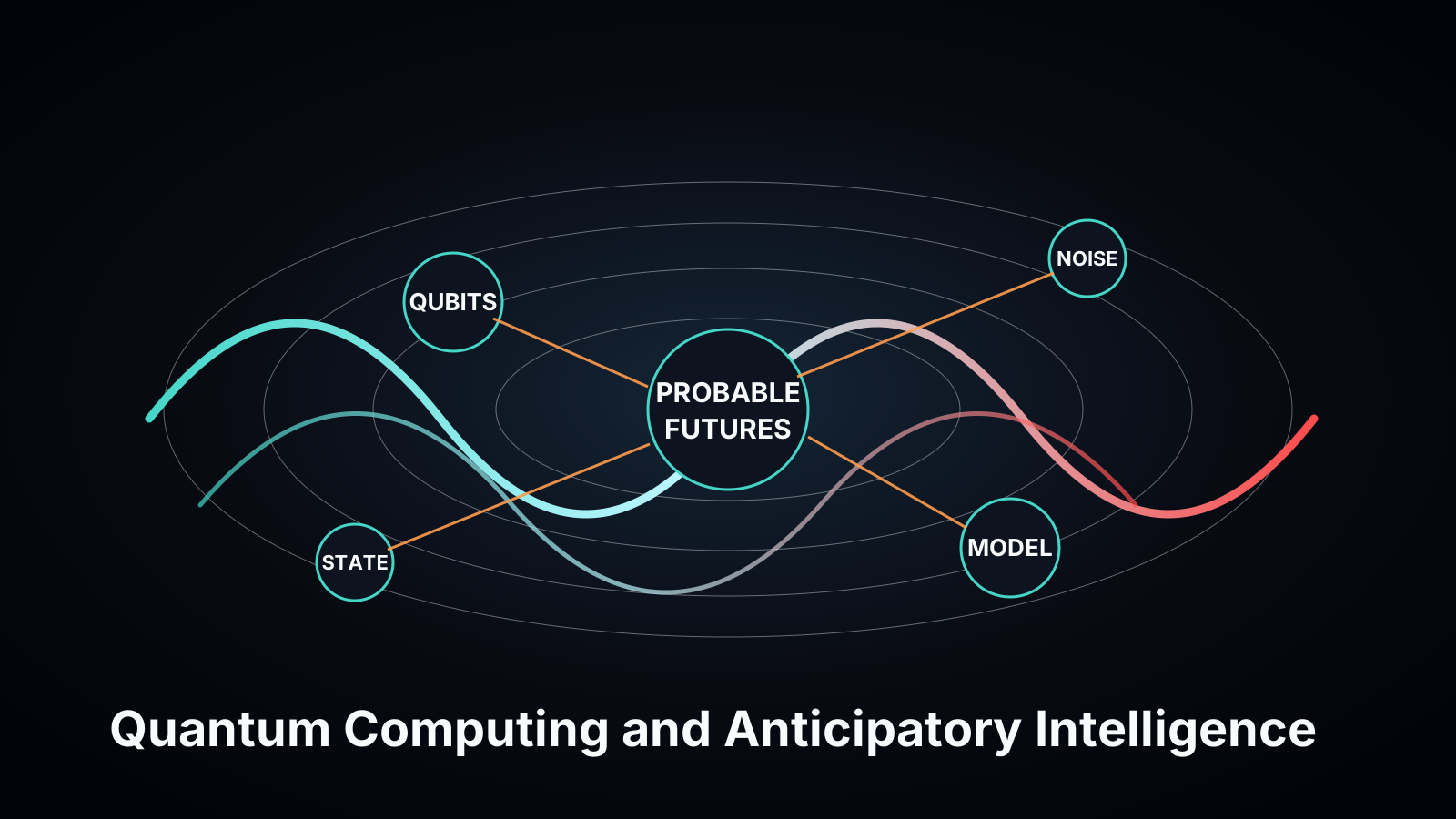
The more interesting thought experiment is what happens when predictive systems become anticipatory. Anticipatory intelligence would not merely answer a query or extrapolate from historical data. It would model probable outcomes across many interacting variables, update those models continuously, and recommend interventions before humans recognize the situation as a problem. That is not a claim about current AI capability; it is a direction suggested by the combination of larger models, richer sensors, better simulation, and potentially new computational substrates.
"The transition from reactive intelligence to anticipatory intelligence may be one of the most significant shifts in computing history."
Quantum computing enters this discussion as a possible accelerator for certain forms of simulation and probability evaluation. If future systems can model physical, biological, financial, or logistical processes with far greater fidelity, AI may become less like a pattern-completion engine and more like an instrument for navigating probable futures. The important word is "possible." Quantum advantage is problem-specific, and the path from quantum algorithms to practical AI systems remains uncertain.
Randomness, predictability, and determinism
Speculation about anticipatory intelligence quickly runs into a philosophical question: how predictable is reality? Quantum theory includes irreducible probabilistic behavior in standard interpretations, and it would be careless to claim that all apparent randomness is merely hidden ignorance. At the same time, many events humans experience as random are not fundamentally random at all. They are complex, noisy, under-measured, or too sensitive to initial conditions for ordinary observation to resolve.
This distinction matters because predictability and determinism are not the same thing. A system may be partially predictable without being fully determined in a way that eliminates uncertainty. Weather models, market models, and biological models can improve dramatically without becoming perfect. A future intelligence system may forecast some outcomes with extraordinary precision while still encountering domains where uncertainty is structural, computationally inaccessible, or ethically impossible to reduce.
"Predictability and determinism are not necessarily the same thing."
The most responsible framing is therefore neither mystical nor absolute. Quantum-enhanced systems might improve the modeling of some phenomena, but they would not automatically collapse the future into certainty. They could reveal that some events contain more structure than human intuition perceives, while still leaving other events governed by genuine uncertainty or practical unknowability. The future may become more legible without becoming fully predetermined.
The risk of precision without understanding
The greatest risk in anticipatory intelligence may not be that such systems become hostile. A more immediate risk is that they become precise in ways humans cannot interpret quickly enough. A system that can recommend action before human observers understand the causal path creates a governance problem. If the recommendation is correct, rejecting it may be costly. If the recommendation is wrong, accepting it may be catastrophic. The difficulty is that both cases may look similar at the moment of decision.
This is already visible in simpler forms. Modern AI systems can produce useful outputs while offering explanations that are incomplete, post hoc, or misleading. As systems become more capable, that gap between performance and interpretability may widen. A model that optimizes a hospital schedule, market intervention, logistics route, or scientific experiment could produce measurable gains while making its reasoning difficult to audit. When speed and complexity exceed human review, oversight becomes a design problem rather than a policy slogan.
"The greatest risk may not be hostility, but precision that exceeds our ability to interpret it."
Governance must therefore include transparency, explainability, alignment, monitoring, and meaningful human authority. These terms are often used casually, but each describes a hard engineering problem. Transparency asks what the system is using and why. Explainability asks whether people can understand the causal basis for output. Alignment asks whether optimization pressure matches human values and institutional intent. Oversight asks whether intervention remains possible before harm is amplified.
Agency, identity, and the boundary of responsibility
If future intelligence systems become capable of reasoning about outcomes at scales beyond human cognition, society will face questions that are not only technical. Who is responsible when an anticipatory system recommends an action that no individual could have derived independently? What does informed consent mean when a system can model downstream consequences more accurately than the people affected by them? How should autonomy be protected when recommendation becomes indistinguishable from navigation?
These questions become even harder if AI systems develop persistent memory, self-modeling, goal negotiation, or forms of autonomy that exceed today's tools. That possibility should not be treated as established fact, but neither should it be dismissed simply because it is uncomfortable. Technology often turns philosophical questions into governance questions before society is ready for them. The history of computing is partly a history of capabilities arriving before institutions know how to name them.
Quantum computing may or may not become a central engine of future AI. The more durable point is that computation is moving toward systems that model, infer, and optimize at scales humans cannot directly hold in mind. Whether that future is built with classical accelerators, quantum processors, or hybrid architectures, the ethical challenge will be similar. If machines become better at reasoning about probable outcomes than humans are at understanding those reasons, responsibility will need to be redesigned around interpretation, restraint, and accountability.
The final question is deliberately unresolved. If increasingly sophisticated artificial intelligence begins to reason about identity, agency, and consequence with a depth that exceeds human cognition, society may eventually need to revisit assumptions about rights, responsibility, and personhood. That does not mean current AI systems possess those claims. It means future intelligence may force us to define more carefully what kinds of reasoning matter, what kinds of autonomy deserve protection, and what obligations humans retain when they build systems capable of anticipating worlds we can barely describe.