



Estimated reading time: 8 minutes.
Table of contents
- The most counterintuitive ordinary answer
- Flatness is geometry, not appearance
- The cosmic microwave background as a ruler
- WMAP, Planck, and converging measurements
- BAO, supernovae, and inflation
- What a flat universe implies
- The strange elegance of ordinary geometry
The most counterintuitive ordinary answer
Modern cosmology points toward a conclusion that sounds almost too simple: the universe appears to be geometrically flat. Not flat in the sense of a sheet, not flat in the sense of a picture, and certainly not flat in the sense used by flat-Earth claims. The statement is about large-scale spatial geometry. When cosmologists say the universe is flat, they mean that, across the observable universe and within current measurement limits, space behaves very close to Euclidean geometry.
That claim is surprising because the universe does not look simple. It contains galaxies, voids, black holes, dark matter, dark energy, gravitational lensing, expanding space, and radiation left over from the early universe. At human scale, even ordinary gravity makes space feel anything but plain. Yet when cosmologists step back and ask what geometry best describes the largest observable scales, the answer is remarkably restrained. The simplest model still survives the data.
"The most surprising answer in cosmology may be the simplest one."
This does not mean every local region is uncurved. General relativity tells us that mass and energy curve spacetime, and we observe that curvature through gravity and lensing. The flatness claim concerns the overall spatial curvature of the universe after averaging over enormous scales. It is a statement about the background geometry in which cosmic structure evolves. The distinction between local curvature and global geometry is essential to understanding why the result is both accurate and strange.
Flatness is geometry, not appearance
The word "flat" creates confusion because people naturally associate it with visual shape. A tabletop is flat, a screen is flat, and a map is flat because they appear two-dimensional. Cosmological flatness is different. It does not mean the universe has only two dimensions, and it does not mean space is arranged like a cosmic sheet. It means the rules of geometry, at the largest measured scales, behave as they would in ordinary Euclidean space.
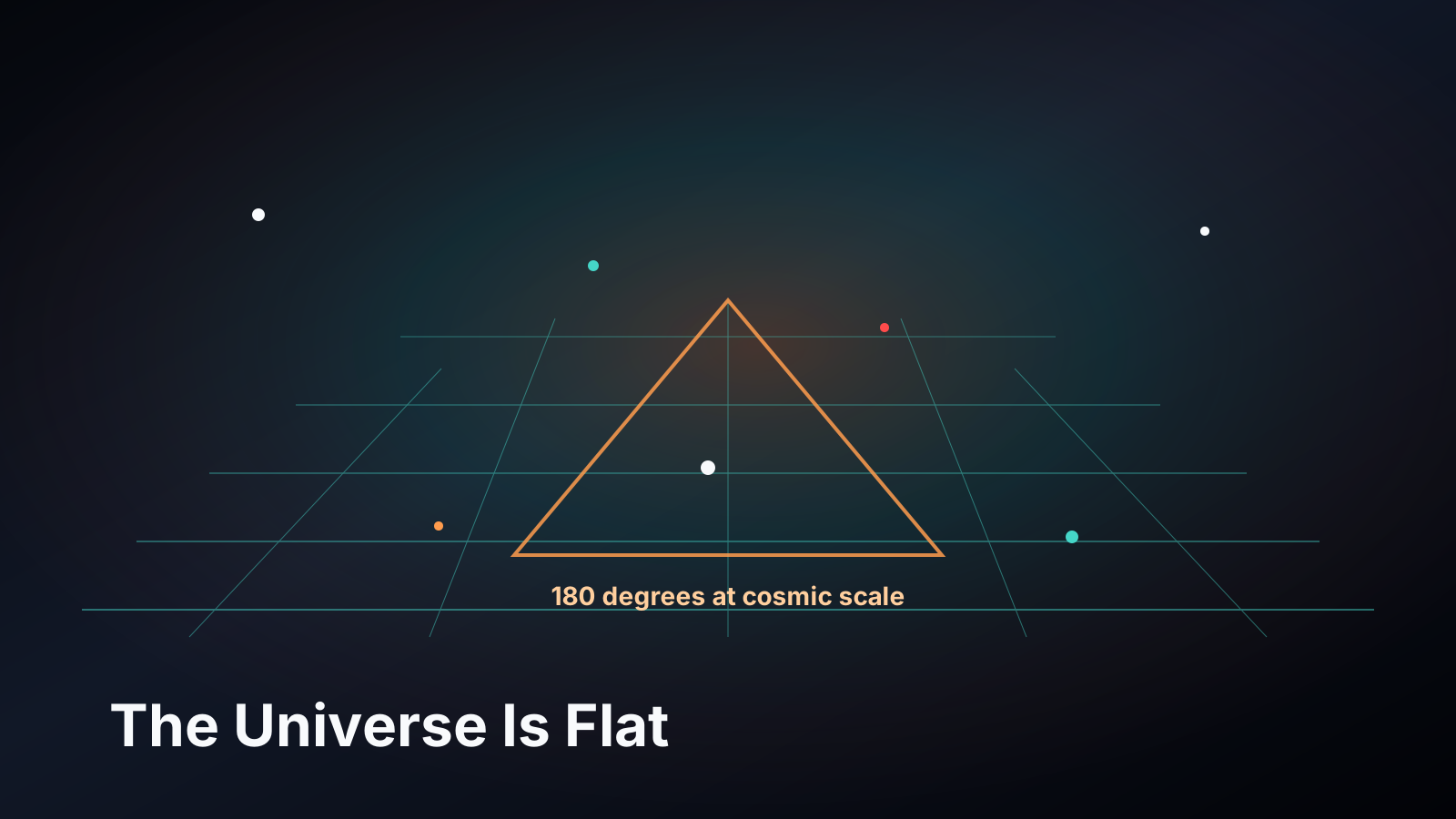
One way to think about this is through triangles. On a flat plane, the angles of a triangle add up to 180 degrees. On the surface of a sphere, a triangle can contain more than 180 degrees, because the surface is positively curved. In a negatively curved geometry, the angles can add up to less than 180 degrees. Cosmologists can use the early universe as a kind of cosmic geometry test, asking whether distant standard features appear larger, smaller, or exactly as expected in a flat universe.
"Flatness is a statement about geometry, not appearance."
I once mentioned this idea in conversation and watched someone briefly mistake it for a flat-Earth argument. The confusion was understandable, because everyday language does not prepare people for phrases like "the universe is flat." The clarification was simple: Earth is not flat, and the claim is not about the visual shape of astronomical objects. It is about whether the largest-scale geometry of space bends positively, bends negatively, or remains indistinguishable from zero curvature.
The cosmic microwave background as a ruler
The strongest evidence begins with the cosmic microwave background, the faint radiation left over from the early universe. About 380,000 years after the Big Bang, the universe cooled enough for light to travel freely, leaving behind a snapshot of early conditions. That light has been stretched by cosmic expansion into microwave wavelengths, and it now reaches us from every direction. Embedded in it are tiny temperature variations that preserve information about density waves in the primordial plasma.
Those density waves created a characteristic scale, often described as a standard ruler. If the universe were positively curved, that ruler would appear at a different angular size than it would in a flat geometry. If the universe were negatively curved, it would be distorted in the opposite direction. Observations of the cosmic microwave background therefore give cosmologists a way to test the geometry of space using the oldest observable light in the universe.
This is why the acoustic peaks in the cosmic microwave background matter so much. They are not merely patterns in a colorful map; they are measurements of how early-universe structure projects across cosmic distance. When those patterns are compared with theoretical models, the result strongly favors a universe whose spatial curvature is extremely close to zero. The measurement is not a philosophical preference for simplicity. It is a consequence of matching the observed sky to the geometry required to produce it.
WMAP, Planck, and converging measurements
NASA's Wilkinson Microwave Anisotropy Probe, known as WMAP, helped turn cosmology into a precision science by mapping tiny variations in the cosmic microwave background across the sky. WMAP measured the age, composition, and geometry of the universe with a level of precision that changed public and scientific understanding. Its results supported a universe very close to flat, consistent with the inflationary picture of the early universe. The importance of WMAP was not only the data itself, but the way it narrowed the range of serious cosmological models.
The European Space Agency's Planck mission refined this picture with even more detailed measurements. Planck's observations of temperature and polarization anisotropies provided a sharper view of the early universe and tighter constraints on cosmological parameters. As with WMAP, the data supported a universe very close to spatial flatness when interpreted within the standard cosmological model and combined with other observations. There are technical debates about parameter combinations and model assumptions, but the broad picture remains that any curvature is small enough to be difficult to distinguish from zero.
These missions matter because they are independent instruments observing the same ancient signal with increasing precision. Cosmology is strongest when different measurements converge rather than depending on one fragile result. WMAP and Planck do not merely show that the universe looks smooth in a general sense. They measure the detailed statistical structure of early-universe fluctuations and compare it with the geometry required by physical models.
BAO, supernovae, and inflation
Cosmic microwave background data is not the only evidence. Baryon acoustic oscillations, or BAO, leave an imprint in the distribution of galaxies. The same early-universe sound waves that appear in the microwave background also influence how matter clusters at large scales. By measuring that clustering pattern, cosmologists obtain another standard ruler, this time in the later universe. BAO measurements help connect early-universe geometry with the structure we observe in galaxy surveys.
Type Ia supernovae provide a different kind of distance measurement. They are used as standardizable candles because their light curves allow astronomers to estimate distances across cosmic time. Supernova observations helped reveal that cosmic expansion is accelerating, and they remain part of the evidence stack used to test cosmological models. When combined with cosmic microwave background and BAO data, supernova measurements help constrain the relationship between expansion history, matter density, dark energy, and curvature.
Inflationary theory also gives flatness a theoretical context. Inflation proposes that the early universe underwent an extraordinarily rapid expansion, stretching any initial curvature until the observable region became extremely close to flat. This is not the same as saying inflation is proven in every detail, but it explains why flatness is an expected outcome in many successful early-universe models. The observational result and the theoretical framework reinforce each other: the universe appears flat, and inflation offers a mechanism that could make such flatness natural.
What a flat universe implies
A flat universe has strange implications. The simplest version is spatially infinite, extending beyond the observable universe without an edge or center. We cannot observe infinity directly, because light has had only a finite time to reach us, but the geometry allows it. The observable universe may be only a finite region of a much larger spatial whole. In that picture, there is no central location from which everything expands; every observer sees distant galaxies receding because space itself expands.
There are also finite but unbounded possibilities. A universe can be geometrically flat while having a nontrivial topology, such as a three-dimensional analogue of a torus. In such a case, space could be finite in volume but loop back on itself without a boundary. This distinction is important because geometry and topology are related but not identical. Flatness tells us about curvature, while topology asks how space is connected.
Uniform expansion follows naturally from the large-scale cosmological model. Galaxies are not flying away from a central explosion through preexisting space. Instead, distances between widely separated points increase as space expands. That is why the absence of a universal center is not a paradox. In an expanding flat universe, every sufficiently distant observer can describe other galaxies as receding, because expansion is a property of the metric rather than a motion away from one privileged location.
The strange elegance of ordinary geometry
"The universe appears astonishingly ordinary until you consider what that ordinary geometry allows to exist."
The word "ordinary" almost feels inappropriate here. A geometrically flat universe can still produce stars, galaxies, black holes, chemistry, planets, biological life, consciousness, and people arguing about the meaning of flatness at a gathering. The geometry may be simple, but the consequences are not. Simplicity at the largest scale does not make the universe less profound. It may be precisely the condition that allows complexity to emerge in a comprehensible way.
The result also says something about the power of measurement. Human beings cannot step outside the universe and look at its shape. We infer geometry from ancient radiation, galaxy clustering, exploding stars, and the equations of general relativity. That indirectness is not a weakness; it is the triumph of modern cosmology. We have learned to measure the structure of reality using signals that began traveling before stars, planets, or observers existed.
The universe is not flat because it is visually plain, and it is not flat because imagination prefers simplicity. It is flat because the best evidence we have, interpreted through the best models available, points toward spatial curvature so close to zero that it remains indistinguishable from flatness at observable scales. Inside that understated geometry, everything we know has unfolded. The largest structure we can measure may follow the simplest rule, and that simplicity is not boring. It is one of the deepest facts we have discovered.